Electrical is where DIY builds go wrong most often — and where buyers should look hardest. The good news: sizing a system is just arithmetic. Add up what you use, add margin, and buy the battery last (prices keep falling).
Step 1: Add up your daily loads
List everything you'll run and its draw in watts, times hours per day. Divide by 12 (for a 12V system) to get amp-hours — the unit batteries are sold in.
| Device | Watts | Hours/day | Wh/day |
|---|---|---|---|
| 12V fridge | 45 | 8 (cycling) | 360 |
| LED lights | 20 | 5 | 100 |
| Laptop + phones | 90 | 4 | 360 |
| Diesel heater fan | 30 | 6 | 180 |
| Water pump | 60 | 0.5 | 30 |
| Total | ~1,030 Wh |
This modest full-time setup uses about 1 kWh per day. Add air conditioning or an induction cooktop and that number triples — which is why honest load math matters more than any single component choice.
Step 2: Size the battery bank
Usable capacity = daily Wh × days of autonomy ÷ system voltage.
- Weekenders (drive daily, 1 day autonomy): 100–200Ah at 12V is plenty.
- Full-timers (2–3 days autonomy): 300–600Ah at 12V.
- Off-grid luxury (A/C, induction): 600Ah+ at 24V or 48V.
LiFePO4 batteries deliver ~90% of their rated capacity vs. ~50% for AGM, weigh half as much, and last 5–10x longer. They cost more upfront but are cheaper per usable amp-hour over the battery's life. For any new build in 2026, lithium is the default — AGM only makes sense for the tightest budgets.
Step 3: Size the solar array
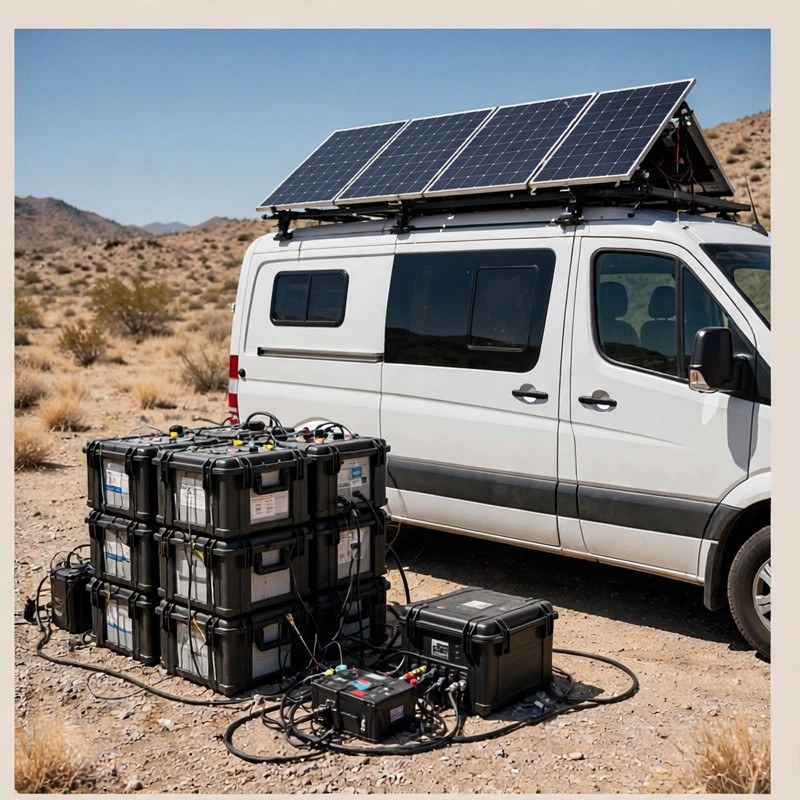
A flat roof panel produces roughly 4–5x its wattage in Wh per day in good sun (200W panel → ~800–1,000 Wh/day). Size solar to replace your daily use:
- 1 kWh/day usage → 200–300W of solar
- 2 kWh/day → 400–600W
- 3+ kWh/day → 600W+ and consider alternator charging too
Solar is a supplement, not a guarantee. A DC-DC charger from the alternator (30–60A) is the most reliable charging source most vans have — an hour of driving can replace what marginal solar gathers all day in winter.
Step 4: Size the inverter
Add up the watts of everything you'll run simultaneously on AC power, then add 25% headroom. Typical picks: 1,000W for light use, 2,000W for a microwave or induction plate, 3,000W for air conditioning. Pure sine wave only — modified sine wave inverters can damage modern electronics.
12V vs. 24V vs. 48V
Higher voltage = thinner wires and less heat for big systems. Rule of thumb: under 3,000W of inverter, 12V is fine and keeps parts common. Over that, 24V or 48V pays for itself in copper alone. When you're browsing vans, check the battery voltage in the spec sheet — it tells you how seriously the builder took the electrical design.
Common mistakes
- Undersized wiring. The #1 cause of melted terminals. Size wire for the breaker, not the load.
- No battery monitor. A shunt-based monitor (not just voltage) is the fuel gauge of your system — budget $150–$200 for one.
- Mixing old and new batteries. Adding a fresh battery to a tired bank drags the new one down. Replace as a set.
- Skipping fuses. Every positive wire gets a fuse within 7 inches of the battery. No exceptions.
- Buying the battery first. Do the load math, then buy — not the reverse.
Evaluating a van's electrical setup? Our inspection checklist covers what to test on a test drive. Browse vans with real electrical specs →